Commercial floor cleaning machines compared
/ specs read the same day
Commercial floor cleaning machines come in four kinds, and the right one is set by how much hard floor your crew cleans in one shift, not by the brand on the side. A compact scrubber for restrooms and small shops, a walk-behind for offices and schools, a ride-on for warehouses. Below are six scrubbers from Tennant, Kärcher and Clarke on path width, tank size, coverage and run time, every figure read from the maker’s own product page on 26 October 2026. None of those pages printed a price.
Our picks
Kärcher BR 35/12 C Bp
Best for restrooms, kitchens and small shops
A 14 in brush on a quick-charging battery with 3.2 gal tanks: light enough to carry into a restroom, and it leaves the floor dry behind it.
Tennant T300e
Best walk-behind for nightly contract work
Paths of 17, 20 or 24 in, an 11 gal solution tank and up to 3.8 hours of run time: one machine for offices, schools and clinics.
Kärcher B 110 R
Best industrial floor washer for warehouses
A 30 in ride-on whose maker prints a practical rate, not only a ceiling: 31,485 ft²/hr on a 4 h battery.
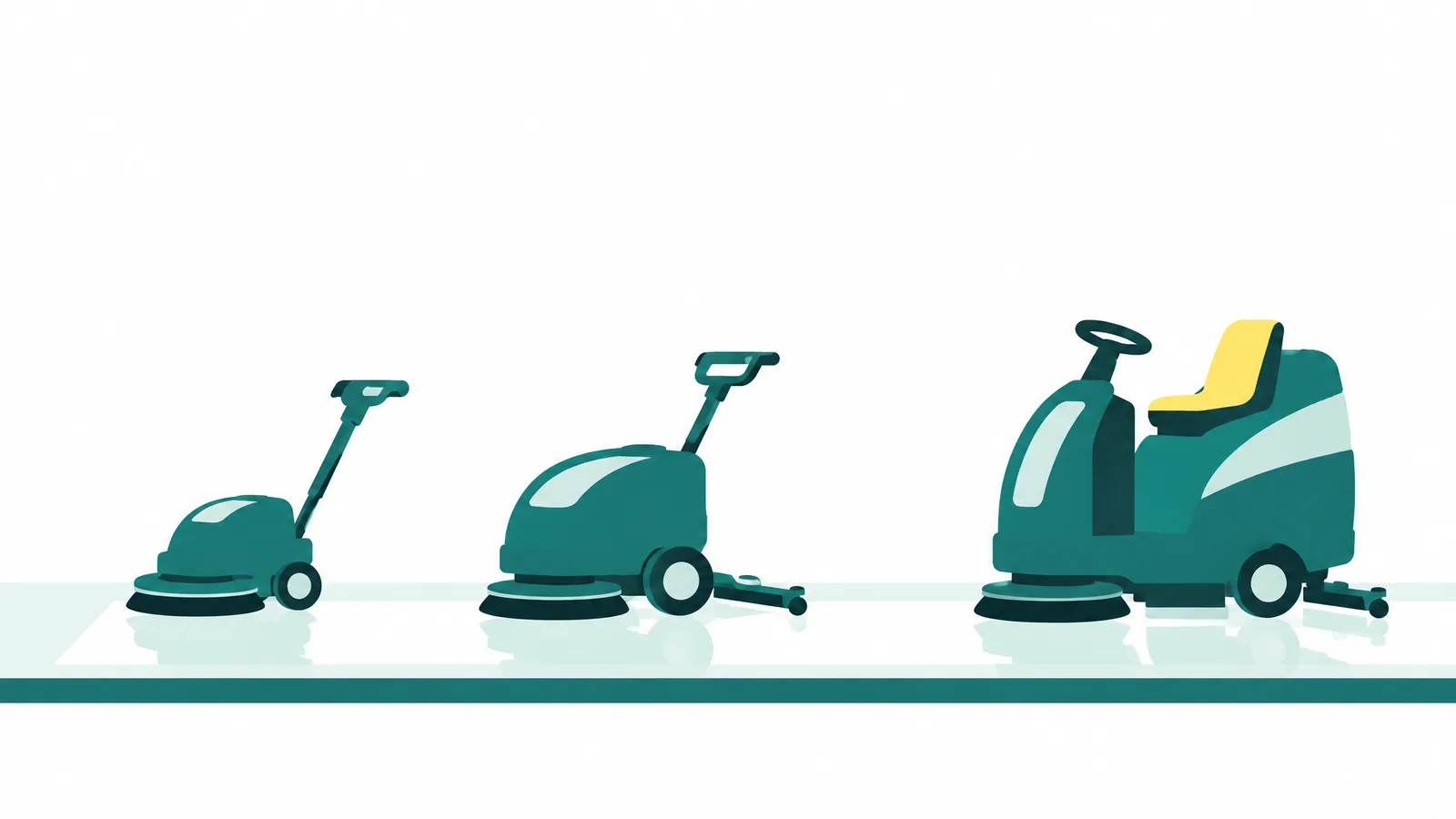
Four kinds of commercial floor cleaning machine
An auto scrubber (also sold as a scrubber dryer or industrial floor washing machine) puts down solution, scrubs, and pulls the dirty water back up through a squeegee in one pass, so the floor is dry behind it. A swing machine only scrubs. That single difference decides most of the labour on a hard-floor account.
| Kind | Earns its keep on | Struggles with |
|---|---|---|
| Swing (rotary) floor machine | Strip, scrub and burnish jobs; floor-finish work sold as a project | Daily cleaning: it scrubs but does not pick up, so a wet vac and a mop follow it |
| Compact scrubber | Restrooms, kitchens, convenience stores, small shops | Open floors: small tanks and short battery life mean refills and recharges |
| Walk-behind auto scrubber | Offices, schools, clinics, retail corridors | Warehouse-size floors: the operator walks every foot |
| Stand-on or ride-on scrubber | Warehouses, big-box retail, gyms, production floors | Small rooms and small accounts; it usually lives on the site it cleans |
Our own reading of the trade; no maker figures in this table
Six professional floor cleaning machines side by side
Six machines from compact to ride-on. The coverage column is each maker’s own figure and they are not the same measure: Kärcher prints a practical rate per hour, Tennant prints an “up to” estimate. Read the next section before you compare them across brands.
| Machine | Type | Path | Solution tank | Maker's coverage figure | Run time |
|---|---|---|---|---|---|
| Kärcher BR 35/12 C Bp | Compact walk-behind | 14 in | 3.2 gal | 10,500 ft²/hr practical | 1.5 h |
| Clarke CA30 20B | Walk-behind | 20 in | not printed | not printed | not printed |
| Tennant T300e | Walk-behind | 17, 20 or 24 in | 11 gal | up to 24,000 sq ft | up to 3.8 hours |
| Tennant T350 | Stand-on | 20 or 24 in | 14.1 gal | up to 38,016 sq ft | up to 4.0 hours |
| Kärcher B 110 R | Ride-on | 30 in | 29 gal | 31,485 ft²/hr practical | 4 h |
| Tennant T7 | Ride-on | 26 or 32 in | 29 gal | up to 56,320 sq ft | up to 4.5 hours |
Kärcher BR 35/12 C Bp product page, read 2026-10-26; Nilfisk (Clarke) CA30 20B product page, read 2026-10-26; Tennant T300e product page, read 2026-10-26; Tennant T350 product page, read 2026-10-26; Kärcher B 110 R Bp + R75 + AGM product page, read 2026-10-26; Tennant T7 product page, read 2026-10-26
The Clarke page printed its 20 in path and onboard charger, but the text we could read carried no tank, coverage or run-time figures, so those cells say so rather than borrow a dealer’s number. Ask the dealer for the spec sheet.
What a coverage figure means for your bid
A theoretical rate is path width times driving speed with no turns, no refills and no furniture. Kärcher prints both numbers for its machines: the BR 35/12 at 15,069 ft²/hr theoretical and 10,500 ft²/hr practical, the B 110 R at 48,438 ft²/hr and 31,485 ft²/hr. The practical figure is 70% and 65% of the theoretical one. Tennant’s spec lists print “up to” coverage with no time unit, but the T350 page’s own copy puts that machine at more than 30,000 square feet per hour, so read them as hourly ceilings, not practical rates, and plan below them.
Kärcher BR 35/12 C Bp product page, read 2026-10-26; Kärcher B 110 R Bp + R75 + AGM product page, read 2026-10-26; Tennant T350 product page, read 2026-10-26
Worked example, our arithmetic: 20,000 sq ft of hard floor a night. At the BR 35/12’s practical rate that is about 1.9 hours, longer than its 1.5-hour battery, so you either recharge mid-shift or buy a second battery. The B 110 R does the same floor in about 38 minutes.
Machine hours go into the bid the same way cleaner hours do. Put the machine’s practical rate in place of a mop crew’s production rate for the hard-floor share of the building, then run the whole job through the commercial cleaning bid calculator.
The best commercial floor scrubber for each account
Restrooms, kitchens and small shops. A compact machine such as the Kärcher BR 35/12 C Bp, which Kärcher pitches at small shops, restaurants, gas stations and restrooms. Its 14 in brush and 3.2 gal tanks are the point: it fits where a walk-behind will not, and it goes back in the van.
Offices, schools and clinics. A walk-behind auto scrubber is the working size for corridors and classrooms. The Clarke CA30 20B runs a 20 in path; the Tennant T300e comes in 17, 20 or 24 in paths, so you can buy the narrow one for buildings full of doorways and the wide one for open lobbies.
Warehouses and big-box retail. This is where an industrial floor washer you stand on or sit on pays for itself, and it usually stays on the client’s site. The Tennant T350 stand-on keeps a 20 or 24 in path for tight aisles; the ride-ons (Kärcher B 110 R at 30 in, Tennant T7 at 26 or 32 in) carry 29 gal of solution so one fill covers far more floor. A machine that size makes sense on a contract long enough to pay it off.
Kärcher BR 35/12 C Bp product page, read 2026-10-26; Nilfisk (Clarke) CA30 20B product page, read 2026-10-26; Tennant T300e product page, read 2026-10-26; Tennant T350 product page, read 2026-10-26; Tennant T7 product page, read 2026-10-26
Noise, chemicals and daytime cleaning
If the client wants cleaning while staff are in, noise matters. Tennant lists the T350 at as low as 63.7 dBA (59.7 in quiet mode) and the T300e at as low as 67 dBA; Kärcher lists the BR 35/12 at 65 dB(A). Each maker measures its own way, so hear the machine in the client’s building before you promise day cleaning.
Tennant T350 product page, read 2026-10-26; Kärcher BR 35/12 C Bp product page, read 2026-10-26
Chemistry still applies. Tennant’s own note says its water-only ec-H2O scrubbing is not suitable for all soils, including heavy concentrations of fats and oils, so a restaurant kitchen floor still needs a degreaser. Mix the tank from the product label, and use the dilution ratio calculator to get the ounces right for the tank size.
Tennant T300e product page, read 2026-10-26
When not to buy a scrubber
If your accounts are mostly carpet, the machine you need is a vacuum, and the best vacuum for a cleaning business guide covers that choice. If the hard floor is a single small kitchen, a flat mop is faster than unloading anything. If the job is stripping and refinishing, that is swing machine work, priced as a project of its own.
The price of a scrubber is a dealer quote, not a number on the maker’s page. Ask for the machine, the batteries and charger, a year of pads and brushes, and the squeegee blades in one figure, and ask what a service visit costs before you need one.
Running a demo on your own floor
Tennant’s product pages carry a free-demo request and Kärcher’s point you to a local dealer. Use that. A demo on the showroom floor tells you nothing; a demo on your worst account at the hour your crew works it tells you everything.
On your own worst floor
- Run the demo on a real account, at the hour your crew works it
- Time one full solution tank from fill to empty
- Check the floor is dry behind the squeegee on turns and in corners
- Measure the narrowest door, lift and corridor it has to pass
- Have your newest cleaner drain and rinse the recovery tank
Before you sign
- Battery type, charge time and where it will charge overnight
- Who services it, and how fast a breakdown gets a visit
- The price of pads, brushes and squeegee blades for a year
- Whether it rides in your van or stays on the client's site